+44 782 583 7455

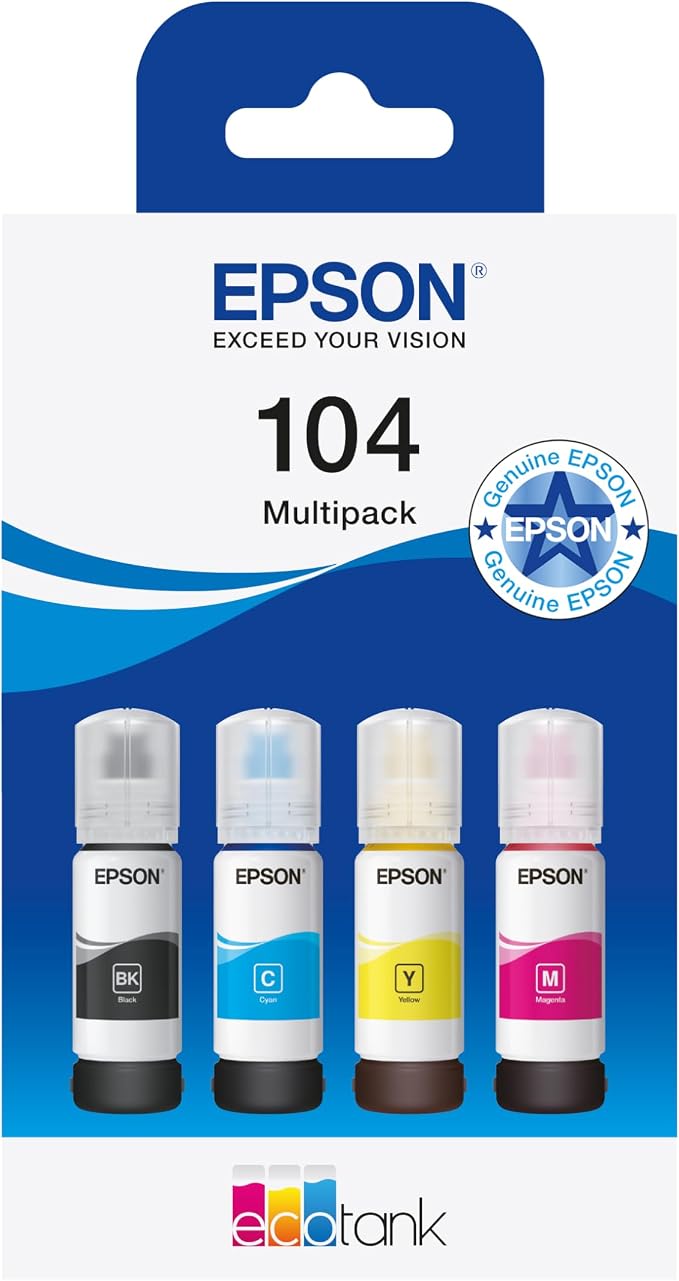
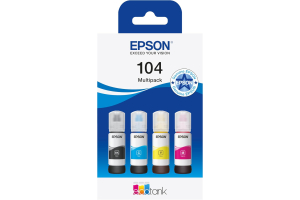
Original product example: Epson 104 EcoTank Ink Bottle Multipack. View this product.
Printer ink does not have one universal shelf life. Check the dates and storage guidance for the exact cartridge or bottle, and distinguish an unopened spare from an installed cartridge or an opened refill bottle.
In this guide
Identify the condition of the inkRead the actual product guidanceStore unopened spares sensiblyHandle opened bottles carefullyInk in a printer is another questionChoosing replacement quantitiesA warranty date, manufacturing date and use-by instruction can mean different things. Do not treat every printed date as the moment ink becomes unusable, or assume that a sealed package guarantees indefinite storage.
Identify the condition of the ink
| Supply state | What to check |
|---|---|
| Unopened cartridge | Packaging, storage instructions and relevant dates |
| Installed cartridge | Printer handling, operating conditions and output |
| Opened bottle | Cap, label and product-specific use-after-opening advice |
| Bottle ink already in a tank | The printer's operation and maintenance guidance |
| Toner | Its own storage guidance; it is not liquid ink |
These are different situations. A time period printed on an opened-bottle instruction should not automatically become a claim about the life of ink already transferred into a printer tank.
Read the actual product guidance
Use the original manufacturer information for originals and the supplier's documented specification for compatible or remanufactured supplies. Do not assume a compatible product has exactly the same storage life because it replaces the same cartridge number.
Check what a date refers to before making a return or disposal decision. If it is unclear, photograph the date code and packaging and ask the supplier. A partially readable code is not a reliable basis for inventing an expiry month.
This guide does not prescribe a universal eighteen-month, two-year or six-month limit across every product. Different ink types, packaging and instructions make that misleading.
Store unopened spares sensibly
Keep cartridges in their original protective packaging under the stated conditions. Avoid direct sun, unsuitable heat, freezing conditions and physical damage. Do not open a spare far in advance simply to inspect it.
Organise supplies by exact family and purchase date so older suitable stock is not forgotten behind newer purchases. Do not mix unlabelled cartridges from different printers in one drawer.
Buy an amount you reasonably expect to use while retaining the machine. A large bundle can lower the headline price per cartridge while leaving several colours unused for a long period.
Handle opened bottles carefully
Keep the label attached and the cap secure. Store the bottle in the orientation and conditions its instructions require. Avoid unlabelled containers, mixed series and reused bottles whose contents can no longer be identified confidently.
Follow the product's own use-after-opening guidance. Do not apply an instruction for one HP bottle to every Epson or compatible bottle. If the bottle is damaged, contaminated or its identity is uncertain, ask before filling a tank.
Do not solve uncertain old ink by mixing it with new ink or transferring it into a different branded bottle. Correct labelling and compatibility remain important even when the liquid appears normal.
Ink in a printer is another question
An installed cartridge's output depends on more than the date it was purchased. Long idle periods, handling and the model's maintenance conditions can matter. A full indicator is not a direct quality or flow test.
If output is poor, use the exact printer's supported diagnostic pattern. Do not assume age proves the cause, and do not run repeated cleaning routines without observing their result and the manual's limits.
Keep working cartridges installed unless the model requires removal. Follow the supported shutdown process rather than routinely pulling every supply out for storage between ordinary uses.
Choosing replacement quantities
Check existing spares before buying. Compare singles, complete sets and additional black against actual consumption rather than the largest advertised pack. Use Find Ink if you need to reconfirm the family.
A product's live price or availability does not establish its storage life. If buying a large quantity, ask for relevant date and specification information rather than assuming all delivered stock will remain usable for a fixed number of years.
Is old ink always unusable?
Not solely because it is old. Check the product guidance, condition and supported diagnosis; do not infer a universal expiry rule.
Can I leave an opened cartridge outside the printer?
Follow the manufacturer's handling instructions. Do not invent a storage method that leaves sensitive areas exposed or touches nozzles.
Does toner dry out like ink?
Toner is a different material and needs its own storage guidance. An ink shelf-life rule should not be copied to toner.
Can I judge a refill bottle by appearance alone?
No. Identity, storage, dates and contamination matter. If those are uncertain, ask before putting it into a printer.